
Leslie’s Scientific Responsibility
Secret InvasionThis arc follows Leslie from curiosity about unidentified eggs to the hard limits of laboratory study and the moral urgency of biosecurity.
increasing Bearing strength in each event
 decreasing
Bearing strength in each eventdecreasingA Rare Specimen
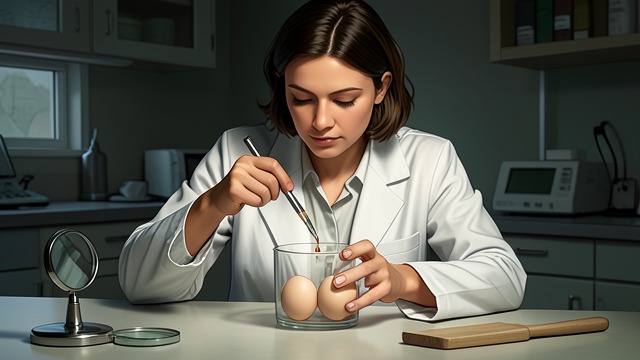
A Rare Specimen
Curiosity under discipline
Leslie receives three intact eggs and is eager to discover what they contain. She resists cutting them open, choosing instead to study their exteriors and take a careful fluid sample.
Science meets uncertainty
The sample does not resemble familiar animal yolk, leaving her without a simple classification. Her restraint preserves the embryos but also leaves her working without the answers she wants.
An Unexpected Hatching
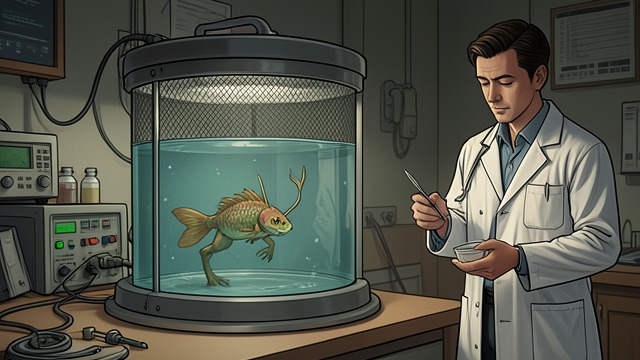
An Unexpected Hatching
The sample comes alive
One egg begins to move while Leslie works. She returns it to its tank, but it hatches almost immediately.
Wonder turns to alarm
The creature’s mixed anatomy astonishes her, then its aggression makes the scientific encounter dangerous. Leslie secures the tank and realizes that a living specimen cannot be treated as a passive object.
Containment Fails in Principle
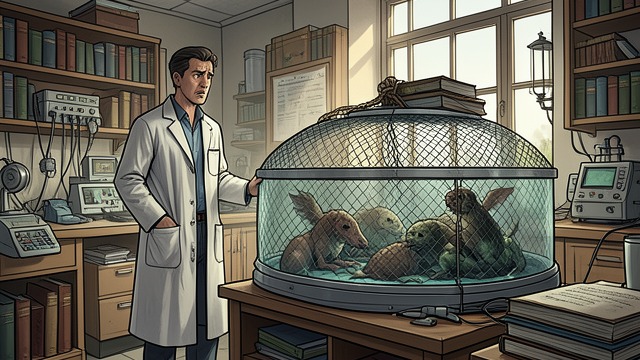
Containment Fails in Principle
Three active animals
The remaining eggs hatch, and the juveniles repeatedly strike their enclosure. Leslie weighs down the mesh cover with books but has no purpose-built containment system.
A precarious laboratory
Her fascination persists even as the risk becomes obvious. The scene exposes a gap between scientific readiness and an organism whose growth, strength, and aggression were unknown.
The Decision to Electrocute
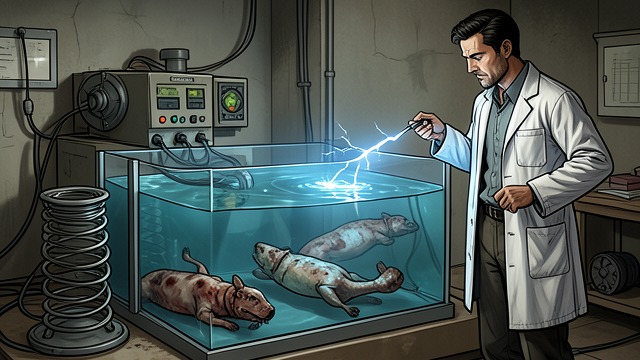
The Decision to Electrocute
Safety overtakes study
After the hatchlings attack one another and then threaten to escape, Ron concludes that keeping them alive is no longer defensible. He improvises an electrical method using the water in the tank.
Knowledge from remains
The animals die, giving Leslie a chance to examine their tissues and later discover developing eggs. The loss of live specimens is troubling, but uncontrolled release would have been worse.
Research in Service of Containment
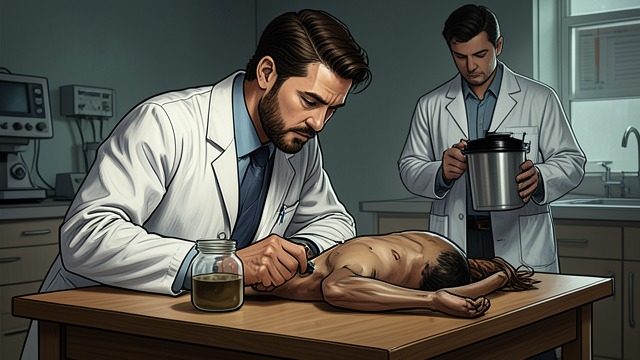
Research in Service of Containment
Findings become instructions
Leslie’s observations help establish why carcasses and eggs cannot be left for scavengers. Scientific work now guides field procedures rather than merely describing an unusual animal.
A scientist’s unresolved task
The operation ends before the substance’s composition is known. Leslie’s responsibility continues in the unanswered questions surrounding origin, mutation, and ecological risk.
The Saturday after the Virginia Beach killing
Later that morning
Minutes after the first hatchling emerges
That afternoon, after a hatchling kills its sibling
During the final national sweeps
